Showing posts with label Forex setting up shop. Show all posts

Complex Trading Systems - Part II

Monday, 9 February 2009


The basic advantages of this approach are:

1. There is no human factor, i.e. a trader, as a person, will be free from excessive emotions. Nerves are kept (relatively) intact!

2. The trader will have more free time. Traders should not be constantly "chained" to the computer screen.

The basic disadvantages of this approach:

1. As all these systems are executed by the client’s computer (within the trading terminal or platform), instead of on the brokerage’s server, it can create a different sort of force majeure situation such as: problems with your РС (computer lock-ups, etc.), power failures or internet connection problems.

2. There is more chance of missing unexpected fundamental news.

The given approach has advantages and also disadvantages – ultimately it is up to you.

Trading Systems offered by financial companies

As has been mentioned before, there are many companies offering “ready for trading” trade recommendations or instant trade alerts (for intraday trading). Charges for these facilities can be monthly, quarterly or annual. These services can be in the form of “ready for use” software, e-mail mail alerts or notifications via instant messenger services.

The cost for such services can be quite high: around $200 per month for trading alerts and more.

Software can be even more expensive. I know of companies offering software for generating trading signals/alerts that costs over $9,000!

In fairness, these services can be very useful for people who are very busy and just unable to watch the markets all the time.


Complex Trading Systems - Part I

Friday, 6 February 2009


Trading Systems created by advanced traders

As a rule, “beginner” traders search for literature devoted to trading financial markets. They study market basics and as they begin to understand how they function, they study the technical and fundamental analysis.

While continuing with their studies, they open a virtual trading account and start to practice their theoretical knowledge.

Of course, it takes time.

Once they start to earn “income” using virtual money, they open the real trading account, fund it with real money and start trading with the intention of receiving a real money profit. A trader looks at various indicators, trying to define which are best suited to their style of trading. In parallel, a trader can use the free and paid services giving trading recommendations.

In due course, step by step, a trader begins to form their own approach to trading based on certain rules for using those particular indicators or other trading tools (a set of carefully chosen indicators, with certain parameters, for example).

Eventually, the trader forms their own unique approach to trading; their trading strategy or trading system.

Put simply, a system consists of identifying a set of events or situations which arise in the market and confirming these as good (or bad) by comparing them with a known set of parameters and technical indicators. When all or most of these events occur at any one time, it is a signal to buy (or sell).

It is important for the systems developed by a trader to be computerized at the earliest opportunity. This will allow their automatic execution without the trader having to be directly involved.

Many trading platforms such as МТ4 allow the user to program algorithms (a procedure or formula for solving a problem, created in the form of a script that is run on your computer) and build them into a trading system. This makes it possible for trade positions to be opened and closed automatically when certain conditions occur.

Technical analysis

Thursday, 5 February 2009

Technical analysis

Technical analysis is research of market dynamics done mainly with the help of charts, and for the purpose of forecasting future price movement.

Technical analysis comprises several approaches to the study of price movement which are interconnected within the framework of one harmonious theory.

This type of analysis studies the price movement in the market by analyzing three market factors: price, volume, and in the case of futures contracts, the number of open positions.

Of these three factors, the primary one for technical analysis is that of price. Changes in other factors are studied, mainly in order to confirm the correctness of the identified price trend. This technical theory, just like any theory, has its core postulates.

Technical analysts base their research on three axioms:

􀂉 Market movement considers everything

This is the most important postulate of technical analysis. It is crucial to understand it in order to grasp the procedures of analysis. Put simply, any factor that influences the price of securities, whether economic, political, or psychological, has already been taken into account and reflected in the price chart.

In other words, every price change is accompanied by a change in external factors. The main inference of this premise is the necessity to follow closely the price movements and analyze them. By means of analyzing price charts and multiple other indicators, a technical analyst reaches the point that the market, itself, shows him/her the trend it will most likely follow.

This premise is in conflict with fundamental analysis where the attention is primarily paid to the study of factors, and later on, after the analysis of the factors, conclusions as to the market trends are made.

Thus, if the demand is higher than the supply, a fundamental analyst will come to the conclusion that the price will increase. A technical analyst, however, makes his/her conclusions in the opposite sequence: since the price has increased, it means the demand is higher than the supply.

􀂉 Prices move with the trend

This assumption is the basis for all methods of technical analysis, as a market that moves in accordance with trends can be analyzed, unlike a chaotic market.

The postulate that the price movement is a result of a trend has two effects: The first implies that the current trend will most likely continue and will not reverse itself, thus, excluding disorderly chaotic movement of the market. The second implies that the current trend will go on until the opposite trend sets in.

􀂉 History repeats itself

Technical analysis and study of market dynamics are closely related to the study of human psychology. Thus, the graphical price models identified and classified within the last hundred years depict core characteristics of the psychological state of the market.

Primarily, they show the moods currently prevailing in the market, whether bullish or bearish. Since these models worked in the past, we have reason to suppose that they will work in the future, for they are based on human psychology which remains almost unchanged over the years.

We can reword the last postulate — history repeats itself — in a slightly different way: the key to understanding the future lies in the study of the past.

Wednesday, 4 February 2009

IMPORTANCE OF THE ECONOMIC DATA

The announcement of a given result is not expected to influence a currency and, most likely, its publication will be little more than a statistical fact

The announcement of a given result is expected to influence a currency for the current session at most

The announcement of a given result is expected to influence a currency for a day, a week or even a month

POSSIBLE INFLUENCE ON AN EXCHANGE RATE 32

→  The output of the economic indicator (presumably) does not render action on an exchange rate

↑  The output of the economic indicator will (presumably) cause growth of an exchange rate

↓  The output of the economic indicator will (presumably) cause a decline of an exchange rate

↓↓  The output of the economic indicator will (presumably) cause strong (very strong) decline of an exchange rate

↑↑  The output of the economic indicator will (presumably) cause strong (very strong) growth of an exchange rate

It is very difficult to predict movement of the currency after the publication of the data (more often it happens before publication of carryovers from sessions of central banks, statements of large political figures, publications of economic reports (the Beige book (USA), Tankan (Japan), etc.)

As you can see, brokerages will try their best to help you with all kinds of trading information. In time, you’ll be able to understand everything very clearly.

Common detailed Fundamental Analysis for an index:

Monday, 2 February 2009

Fundamental Analysis: ISM services index

The last value on the chart above shows predicted data

Analysis: This index was in an uptrend from the end of 2001. During 2002 it stayed above 50, signifying that the service sector was increasing. From the middle of 2003 this index stabilized within the indicated range. Its decrease in September was triggered by the hurricane and, though it recovered in October, it is still quite low.

Conclusion: This index signifies some weakness in the mid-term perspective. ISM services index for March may be more positive than forecast.


2nd example of Fundamental Analysis for a day

Notes: Above the forecast – the actual value is mathematically larger than the forecast value (for example, 5% > 4.3% and -49 > -51).

Below the forecast – the actual value is mathematically smaller than the forecast value (for example, 4.1% <>

Fundamental analysis does not provide absolute indication in market analysis and will always consist of a complex of possible tendencies.

The level of importance of each economic indicator can be deduced by studying the influence that indicator exerted on an exchange rate over a period of several years.

The level of importance of a given indicator can be over or underestimated depending on the market conditions at the time and the degree of expectancy by a market of the announced result.

How to Forecast Market Behavior

Saturday, 31 January 2009

Can we forecast the future?

Why yes, of course! Any financial market can be analyzed and forecast in some way.

Through the medium of specialized sciences we call technical and fundamental analysis we can assess the probabilities of a market’s direction in the future.

Fundamental Analysis

Fundamental analysis is an analysis of a country’s national qualities (macroeconomics). Fundamental analysis is more pivotal in its power to move the markets with the whims of its daily, weekly, monthly, etc. economical news releases.

Any kind of breaking news, such as some unexpected event of national importance, can break any market prediction that is based on technical analysis alone. We will discuss technical analysis much more in the next section.

The most important macroeconomic indicators are:

1. Factors influencing the market include: Consumer Price Index (CPI), Orders for durable goods, Employment data, Gross National Product (GNP), new house construction, international trade balances, personal income and outlay, Producer Price Index, retail sales, etc.

2. Other important indicators: Beige book, Consumer confidence, Current account, session of the Federal Open Market Committee (FOMC Meeting), Leading Indicators, initial requirements of unemployment benefits (Jobless claims)

3. Reports of heads of the governments, heads of the central banks, outstanding economists concerning a situation in the market 

4. Changing monetary and credit policy

5. Sessions of the big seven - the trading and economic unions

There is no real need to worry about “surprise” results. These macroeconomic indicator reports are published at known times of the year and rarely contain unexpected results.

Here is a typical example for one day:

As you can see, the right hand part of the table (above) consists of three columns: Prior, Forecast and Actual.

"Prior" means that a previously defined index had some value in the past for a defined period of time (week, month, quarter).

"Forecast" means economists and professional traders, based on specific calculations, are waiting for this index value for the week, month or quarter.

"Actual" means the real value of the index is unknown (or, at least, unpublished) so far.

Of course, if you are a beginner, then these aspects can be difficult to understand.

Don’t worry! Help is at hand.

Most brokerages offer a service providing this information to their clients free of charge.

The Main Market Participants - Part II

Monday, 19 January 2009

Companies making foreign investments

These are those companies involved with Investment Funds, Money Market Funds and International Corporations.

These companies show constant demand for foreign currency (as importers) and offer foreign currency (as exporters). Also, they place spare funds on short-term deposit.

At the same time, companies with direct access to the currency market do not, as a rule, effect conversion and deposit operations through commercial banks.

These companies, represented by various international investment funds, operate a portfolio strategy for investment of assets, arranging funds in securities of the Governments of different countries. In dealers’ slang they are referred to as funds, the most well-known of which are G. Soros’ “Quantum”, for successful currency speculations, and “Dean Witter”.

Other types of companies that belong in this category are the great international corporations, creating foreign production investments: the creation of offices, combined business, etc. such as Xerox, Nestle, General Motors, British Petroleum and others.

Central banks

Their main task is currency regulation of their internal market - staving off sudden jumps in rate of a national currency to avoid economical crisis, maintaining a balance of import-export, etc.

Central banks have an influence on the currency market. Their influence could be direct – in the case of currency intervention, or indirect – through regulating the volume of money supply and bank rates.

They are not to be confused with bulls or bears, as their role involves the resolution of international financial issues being faced at a given moment.

A central bank could affect the market independently, to influence its national currency or, in co-ordination with other central banks to arrange a combined currency policy with the international market.

The banks with the most influence on world currency markets are: The United States (the US Federal Reserve or FED), Germany (Deutsche Bundesbank) and Great Britain (the Bank of England, the so-called ‘Old Lady’).

How a Transaction Is Carried Out

Tuesday, 13 January 2009


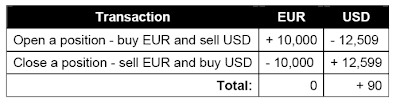
So, you speculate that EUR/USD is moving higher and you buy 10,000 EUR and sell 12,509 USD.

Assuming that you are right and EUR/USD reaches 1.2599/1.2603, you close the open position with an opposing one.

In our example, you close the long (buy) position with a short (sell) position, i.e. you sell 10,000 EUR (0.1 lot * 1.0 lot size for EUR/USD) and buy 12,509 USD: 

You get a profit of 90 pips = $90 in this case. Importantly, you didn't require 10,000 EUR ($12,509) to make the trade, just $125.

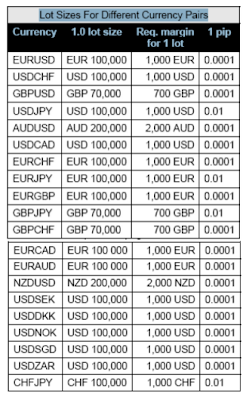
A Pip or point is the minimum rate fluctuation. For EUR/USD, 1 pip is 0.0001 of the price (see Table 2). Our profit is 1.2599 - 1.2509 = 0.0090, i.e. 90 pips.

So, you invested $125 and made a profit of $90.

The time period to achieve this could be anywhere between a few seconds and several days. Assuming that it actually took a few hours, a profit of $90 for an investment of $125 and no actual “work” isn't a bad return at all.

However, you must be aware that leverage can also work against you and magnify your losses.

Only money management will help you to minimize the risks, ideally reduce them to zero, and increase the return from your funds to 10%, 20%, 30%, or higher each month.

One question is left: what is the broker's charge for the leverage they provide?

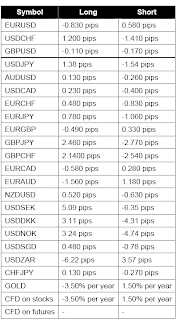
If you open and close a position before 23:00 GMT, brokers provide the leverage for free. If you leave your position open, they adjust your account with a storage charge for the overnight position. It can be either positive (credited to your account) or negative (debited to your account) depending upon the interest rates in those countries.

For example: ECB interest rate is 4.25%, FED interest rate is 3.5%. Assume you have a short position on EUR/USD of 1.0 lot so you have sold 100,000 EUR. This means you have borrowed them at 4.25% per annum.

You sold Euros and bought Dollars, which can be deposited at 3.5% per annum. As a result, the costs are (4.25% - 3.50%) per annum or $937.50 per year (if the EUR/USD rate is 1.2500), or $2.57 per day.

This means that your account will be debited with $2.57 every day for each lot if you have a short (selling) position on EUR/USD and credited with $2.57 if you have a long (buying) position.

In practice, the debited amount is a little higher than 2.57% and the credited amount is a bit lower. The difference goes to a broker as a payment for the rollover.

Swaps

Note: the storage charge for the rollover from Wednesday to Thursday is three times higher than for a position held over any other night.

This is because in the spot currency market, the funds ordered when you open a position are not received until 2 business days after the position is opened and by the same token, if you close a position, the funds are not returned for 2 business days.

For positions opened on Wednesday and closed on Thursday, that would mean receipt on Friday and, therefore, rollover would be for Friday, Saturday and Sunday nights before being returned on Monday. Sorry if that seemed overly complicated – it probably was!

The main thing you need to remember is that you will see a much larger rollover charge if you hold a position over Wednesday night.

What is FOREX?

Monday, 12 January 2009

FOREX (FOReign EXchange Market)

The Foreign Exchange Market is the arena where a nation's currency is exchanged for that of another at a mutually agreed rate. The FOREX market was formed in the mid ‘70s, when international trade was changed from a system of fixed rates to a system of free-floating rates of exchange.

In fact, every country’s currency is considered merchandise, like wheat or sugar; it is the same medium of exchange, like gold and silver. Since the world changes faster and faster every year, the economic conditions of every country (e.g. labor productivity, inflation, unemployment, etc.) are ever more dependant upon the level of development of other countries, and this, in turn, impacts the value of a country’s currency in relation to the currencies of other countries. This is the main reason why there are rate fluctuations.

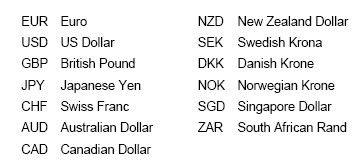
Currency Symbols:

Table 1


Currency Exchange Rate

Currency exchange rates are simply the ratio of one currency valued against another. For example, "EUR/USD exchange rate is 1.2505" means that one euro is traded for 1.2505 dollars.

The exchange rate of any currency is usually given as a bid price (left) and an ask price (right).

The bid price represents what has to be obtained in the quote currency (US Dollar, in our example) when selling one unit of the base currency (Euro, in our example).

The ask price represents what has to be paid in the quote currency (US Dollar, in our example) to obtain one unit of the base currency (Euro, in our example).

The difference between the bid and the ask price is referred to as the spread.

Table 2

Let's assume the exchange rate for EUR/USD is: 1.2505/1.2509. You may have done some market analysis and decide the EUR/USD rate is moving higher (at least to 1.2600) so you buy 0.1 lot (minimum contract size) of EUR/USD at the 1.2509 ask price.

Table 1 will help you define what the contract size is, i.e. 1.0 lot for EUR/USD is 100,000 EUR so 0.1 lot (our contract size) is 10,000 EUR.

This means you bought 10,000 EUR and sold 10,000 * 1.2509 = 12,509 USD.

Now, in order to make a trade, you don't need to have the total amount of $12,509. You actually require just 1/100th of that amount ($125.09) as the rest of the money (in our example, $12,383.91) is leveraged to you by a broker (a company you entered the contract with to enter the market).

Leverage

Leverage is the term used to describe margin requirements - the ratio between the collateral and borrowed funds i.e. 1:20, 1:40, 1:50, 1:100. Leverage 1:100 means that when you wish to open a new position, you only deposit 1/100th of the contract size.

Final Observations

Sunday, 11 January 2009

By now it must be apparent to you, after my many references to it, that I believe Forex trading and gambling are closely related. Consider this. Both are somewhat random in nature. Black can appear ten times in a row on a roulette wheel. Then go black, red, black ten times in a row.

With Forex you may have a full day of small cycles that end up right where they started.

The next day prices may soar and never look back. In that way they’re both similar.

But, what does a casino have that most of us don’t have? Why do they seem to thrive while their visitors go home broke. The answer is easy.

Casinos are mindless entities that have an edge on every dollar wagered. No matter how long it may take, they always come out ahead simply because they have the edge. The odds are always in their favor.

If we accept this concept as fact, then it stands to reason if we can perform as a casino we will also prosper. But, to do that we must create our own edge. We must think, not as a mindless entity, but as someone who has the edge and knows how to use it.

That’s what I’ve tried to instill with you in this report. Casinos do not make a killing! They are content to rake in a certain percentage each day. We must do the same if we are to become successful traders.

You’ve been given the tools in this manual that will give you the edge. I call these tools the Keys to the Code for successful trading. They work. But you must use them carefully. If you choose to ignore or violate them you run the risk of “gambler’s ruin.”

Every casino game has a limit as to how much you can bet (as well as how little). Why do you think that is so?

It’s because they want to limit their exposure to risk.

To control our risk we must do the same. No matter how much cash you have burning a hole in your pocket you can’t violate the rules I gave you back in this blog: Let me refresh your memory:

1. We never risk more than 2% on any one trade.

2. We quit for the day if we’ve made five percent on our money.

3. We quit for the day if we’ve lost ten percent.

4. We also quit at 3:00 PM Eastern no matter where we are simply because the markets slow down around that time when the New York trade goes home.

Lastly, you must want to be a winner! Bruce Lee was told by doctors he might never walk again. Nearly broke and crippled, he visualized writing down all these negative thoughts on a piece of paper. Then, he’d see himself crumpling it up and throwing it in the trash.

Six months later he was a martial arts legend.

Bruce Lee was the hardest working person I’ve ever known. He never stopped learning. He never stopped innovating, and he never gave up his quest for doing the best he could.

Bruce once explained, “If you always put limits on yourself, both physical or otherwise, you might as well call it quits.”

I hope you’ll take those words to heart and let me know what plateau you’ve achieved in your reach for success in the Foreign Exchange Markets.

Tips and Tricks - Part II

Friday, 9 January 2009

If you feel like you may be this type of trader, you might want to use a procedure I developed to help define a trader’s profile.

You see, many traders – myself included – tend to be more visually oriented. Others, especially those whose language is learned by memorizing characters, such as Chinese and Japanese, rather than sounds like phonics, are more “numbers” oriented. At a glance they can see the picture by reading the numbers.

For that reason I created a form to assist traders who are more “numbers” oriented. Right down is an example. It is the high, low close of each 15 minute bar of the chart below. Once again, there is a blank form you can copy in the appendix.


Of course, this isn’t easy to do. You must write down the numbers every fifteen minutes. But, if done properly it can pay off. Take a look at the column labeled STO. Remember the numbers I told you on the end of the post Constructing Our Charts  that sit on the bottom of the left side? 

These are the figures for the hidden line of the “fast” stochastics. Although they are not always consistent as they move up and down, they are almost  always accurate at calling the turns. Even more important they can often tip us off to an extreme  movement. 

At 5:30 prices peaked at 1.4171.6. STO peaked at 86. An hour and a half later prices peaked again at exactly the same price, 1.4171.6. They never went higher. But look at STO. It could only reach 63, the same level as the previous low at 6:30. 

Want to know how far prices fell? Exactly 46 pips, down to 1.4125.6!

 I’ll finish up this post by giving you a secret tip I use so I don’t have to watch my screen all the time. OandA doesn’t have an alert (sound signal) you can just type in when you want it to beep. It only sounds when a buy or sell order is touched. 

So, I use a buy or sell order at the price I want it to beep. But, I only use 100 units so it makes little difference if I win or lose on such a small trade. And of course I only place a buy order if I’m buying and a sell order if I’m selling.

Tips and Tricks - Part I

In this post I’m going to clean up all the loose ends and answer any questions you might be asking at this point.

For example, how do you know when prices are peaking or bottoming out? If I knew the answer to that I wouldn’t be telling anyone. But there are a few clues.

One of them is simply exhaustion. Prices run out of gas. They may rise dramatically, fall back, and try again to go higher. If they can’t, and instead start to fall, that’s a pretty good sign the upswing is over.

You’ll often see this on the fifteen minute chart. The “wick” at the top of the bar is unusually long. Like this Trading Day - Chart 2.

Remember I also mentioned on the post Constructing Our Charts how I hide the jerky line but often look at the number on the lower left part of the chart as it rises and falls. It often peaks and bottoms at the turns.

I also keep track of the previous swings, as I’ve shown you, so I can anticipate a top or bottom. I can also see that on my P&F chart, especially when prices are in a congestion phase.
All of these things help me judge a turnaround, but of course are never a sure thing. That’s why I use very tight stops.

If I do get stopped out, I can always get back in. That’s the beauty of the Forex markets. There’s always another train coming through the station.

How do I handle “add-ons?” These are additional trades, usually on a “long roll” move that I add on when I’ve already got a good profit going for me.

If I am adding to my trade, I’m very careful not to let it interfere with my original position. I treat them separately. About halfway through the trade if I’m pretty sure things are going my way I may add half of what I originally bought or sold to the trade.

If I started with 100,000 units I may add another 50,000 units roughly half way from my entry point to the target. I place a stop on this new position just as I would if it was an original trade. I also make sure my stops are tight enough so the whole package doesn’t turn into a loss.

I’m also constantly aware of how much I’m going to make. As soon as I see prices are getting close to earning five percent, I quickly revise my target accordingly. I can’t emphasize this enough. Make your five percent and go home! 

This also brings to mind the automatic default “stop loss” and “take profit” found in the preferences which I touched on previously. Go to Tools=>User Preferences=>Trading.

What we are doing is selecting the number of pips we initially want to appear when we place our order. I use a default stop loss of 10.0 and a default take profit of 5.0. Then, when I select a limit order these figures are automatically calculated for the price I select. 

Another thing we saw when opening our account was the need to select what margin or leverage you wish to use. What this means is basically how large a position you can carry for the amount of money you have in your account.

OandA has a very conservative approach to leverage which I heartily endorse. The maximum leverage you can use is 50:1, compared to some firms that allow up to 100:1 and more. A higher amount can often result in a margin call, in which case your entire position is closed out to protect your funds.

You can change your leverage by going to Account=>Change Leverage and log in to change your figure. I use the highest, 50:1, since I use stops at all times. I’ve never had a margin call.
Visit http://fxtrade.oanda.com/fxtrade/margin_rules.shtml for more info.

Previously, I also mentioned how you can often use a “long roll” day to help you trade the latitude lines. Many traders simply can’t handle the stress of holding a position which may be moving in the right direction but swinging wildly.


Managing The Latitude Lines

Tuesday, 6 January 2009

Now I want to show you something that can make your job a little easier when it comes to selecting your latitude lines. Some of my traders use this method exclusively and truly swear by it. This method works great with a choppy environment, as well those periods when the markets are quiet, like the middle of the day. I’ll let you decide if it’s right for you.
Basically, we analyze past swings to determine the direction and distance of the next swing that might give us a profit from one latitude line to another.
We do this by keeping track of past swings, and then averaging them out to see how far the next swing might move. If the next swing could cross two latitude lines then we would have a winner. This 5 minute chart from October 24th 2007 is a good example.
I use a log that helps me keep track of the swings. Each time I believe a high or low has occurred I jot it down in the appropriate column (note I often use just the last two digits plus the pipette, i.e. 35.7). I also log the time, since often the time difference between swings can help me determine a turn.
But mostly I rely on a unique program I created with Qbasic that shows me what the length of the next swing might be. Here is the basic formula in longhand.
First of all, to get an average of past swings, we could simply add up the last three up or down swings and divide by three.
A better way is to "smooth" the figure by multiplying the previous up or down average by two, adding today's swing, and then divide it by three.
For example, if we take the UP avg. at 15:50 (see log of the 5 minute chart on next page) of 12.6, and multiply it by 2, we get 25.2. Add that to the upswing at 18:10 of 17.0, and we get 42.2. Divide 42.2 by three and we get 14.1 rounded off. If we did a simple average of the last three swings we might get a distorted figure. By the way, the first entries on my example (10.2 and 11.8) are just arbitrary figures based on earlier swings.
How do we use the average? We simply add or subtract the last up or down average to the high or low and get a “target” point. If it appears the move would cross two or more latitude lines then we could plan our trade accordingly. It’s surprising how accurate the target often hits its mark.
If you want to use Qbasic to speed up your calculations I’ve reproduced a copy of the program at the end of this chapter. Simply copy it as you did in our previous chapter on using Qbasic. I’ve also reproduced a blank copy of my log in the appendix.
Then used, it doesn’t matter if the swing is going up or down. Just follow the instructions. The 25% figure applies to the average we obtain and, as we’ve seen earlier, can be helpful in determining if a turning point is valid.


Highlight and copy (Ctrl + C) this program. Then paste (Ctrl + V) to Notepad. Save it as Avg.bas and move it into the Qbasic folder.

10 PRINT
20 INPUT " HIGH NUMBER: ", A
30 IF A = 1 THEN 220
40 INPUT " LOW NUMBER: ", B
50 INPUT " LAST AVG UP/DOWN ", C
60 LET D = A - B
70 LET X = ((C * 2) + D) / 3
80 LET Y = X * .25
90 D = INT((D * 10) + .5) / 10
100 X = INT((X * 10) + .5) / 10
120 Y = INT((Y * 10) + .5) / 10
130 V$ = " DIFFERENCE: "
140 W$ = " NEW AVG: "
150 K$ = " 25%: "
160 PRINT
170 PRINT V$; D
180 PRINT W$; X
190 PRINT K$; Y
200 PRINT
210 GOTO 10
220 END

The printout will look like this:

Setting up Shop

Tuesday, 16 December 2008

Let’s log on to our trading website, http://oanda.com. There are many things to learn, but if you just want to start trading that’s what I’m about to show you. Most firms, including OandA, have two kinds of accounts. An actual trading account and a “demo” account that works the same way. If you’ve never traded before then I would suggest the demo account at first, then open a real account for maybe $100 until you become more experienced. That’s right, you can trade with as little as one dollar.

Once you’re on the home page scroll down to “About OandA” on the left side. After reading about the company, which is pretty impressive, go to their FAQ site a http://www.fxtrade.com/whyfxtrade.

Go back to the home page and select “Open New Account” under the FXTrade or the FXGame, which is their demo account. If you decide to open an actual account you need to fund it. The simplest way is with PayPal. If you don’t have a PayPal account go to http://www.paypal.com and click on “sign up.” and follow the instructions. You can use a credit card and/or a bank account to deposit funds. Then go back to OandA and log in. Go to “deposit Funds” and follow the instructions. It’s easy and it’s secure.

You must first submit a form, for security purposes, that tells them you are going to submit funds. Follow the instructions, but be sure to click on “Log in to cash management” to advise them you are sending funds. The rest is easy. You will have to pay a small fee to transfer funds. Don’t worry about it. You will soon make up this fee.

Are you ready to go? Because you’re about to enter the “big time.” It doesn’t matter if you’re just starting out with $100 or $100,000. You’re going to double your money if you follow the rules I’m going to outline.